 Pomofast
The Pomodoro Technique, Explained: Why 25-Minute Focus Sessions Work
What the Pomodoro Technique is, the six steps, why short timeboxes beat willpower, the mistakes that make it fail, and how Pomofast runs the cycle.
By Sean Bennett · · 7 min read
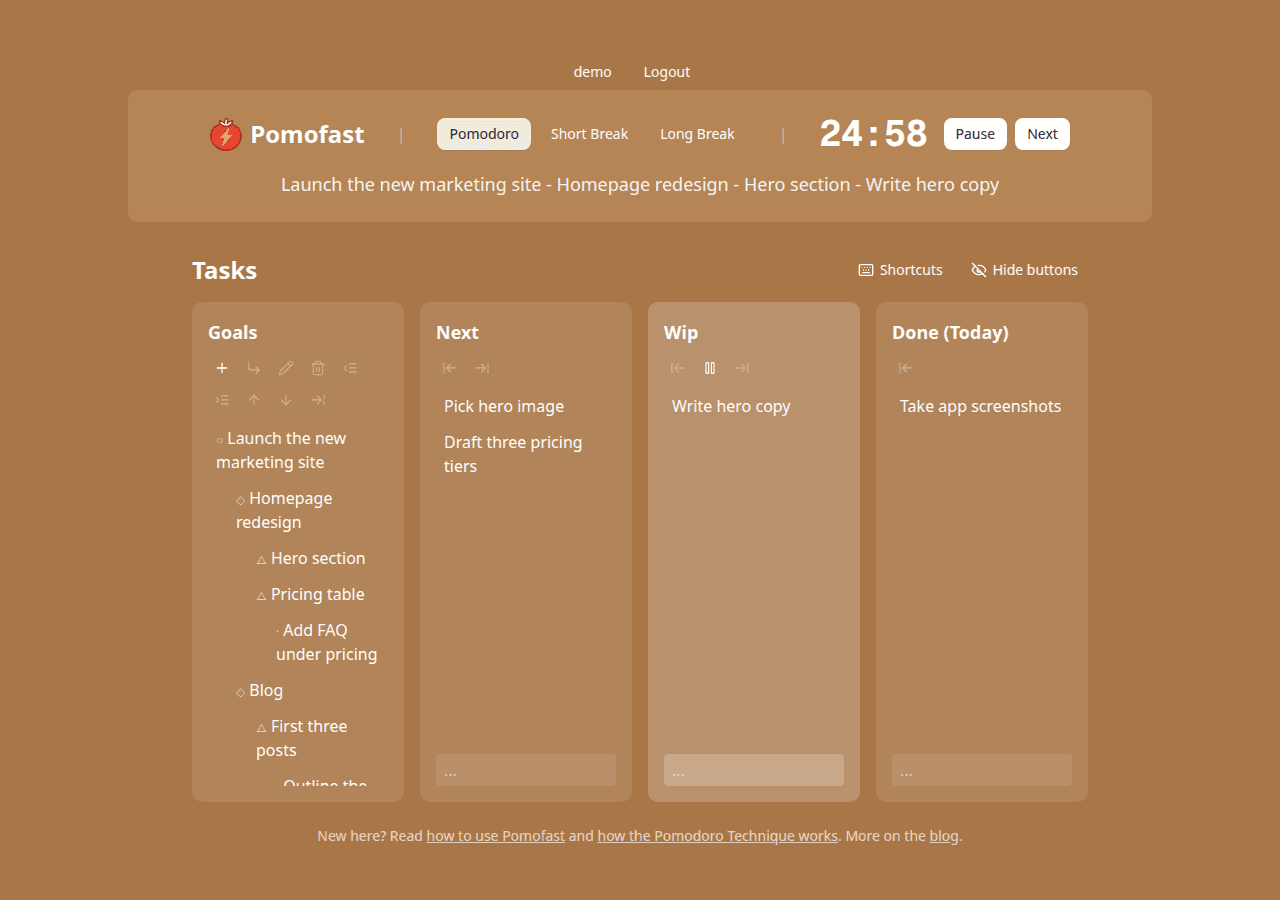
The Pomodoro Technique is the simplest productivity method that actually survives contact with a real workday: pick one task, work on it for 25 minutes, take a 5-minute break, repeat. This guide covers what the method is, why the short intervals work, the mistakes that make people abandon it, and how the cycle runs inside Pomofast.
What is the Pomodoro Technique?
Francesco Cirillo developed the technique in the late 1980s while studying at university. Struggling to focus, he grabbed a tomato-shaped kitchen timer (pomodoro is Italian for tomato), wound it up, and promised himself he would study until it rang. It worked, and the name stuck.
A single pomodoro is one uninterrupted interval of focused work, traditionally 25 minutes. The method wraps that interval in a few rules about breaks and interruptions. That is the whole system. There is no app requirement, no special notebook, and no scoring. The timer does the heavy lifting.
The six steps
- Choose one task. Not a project, a task: something you can make visible progress on in under half an hour.
- Start a 25-minute timer. The commitment is to the timer, not to finishing the task.
- Work until it rings. If something else pops into your head, write it down and return to the task. Do not switch.
- Mark the pomodoro done. A tick on paper, a counter in an app. Counting matters later for estimating.
- Take a short break of about 5 minutes. Stand up, get water, look out a window. Not email.
- After 4 pomodoros, take a long break of 15 to 30 minutes before starting the next cycle.
Why short intervals can help
The technique looks almost too simple to matter. Its structure targets three places where focused work often falls apart, although 25 minutes is a convention rather than a scientifically proven optimum.
Starting is the expensive part
Procrastination often shows up before the work begins. “Finish the report” can feel intimidating; “work on the report for 25 minutes” is a smaller request. The timer replaces an open-ended commitment with a fixed one that may feel easier to begin.
Attention is a consumable
Sustained concentration can become tiring. Research on micro-breaks finds clearer benefits for vigor and fatigue than for objective performance, while studies of fixed Pomodoro schedules have produced mixed results. Scheduled breaks may help you preserve energy, but they are not a guaranteed productivity boost. Our evidence-based review of Pomodoro’s benefits separates the direct findings from the broader research.
Interruptions get a queue instead of a veto
Inside a pomodoro, the rule is that nothing else gets to interrupt. A thought about lunch, an email you should answer, an idea for another project: all of it goes onto a list to handle in the break. The interval is short enough that deferring by 20 minutes is never a real problem, and long enough that you get real work done between the deferrals.
Time becomes countable
Once you tick off pomodoros, you learn how long things actually take. “That kind of task is usually three pomodoros” is a far better estimate than a guess in hours, and it makes planning a day honest. Our guide on planning your day with Pomodoro builds on exactly that.
Common mistakes
- Picking a task that is too big. If a task needs more than a few pomodoros, split it. The feeling of finishing things is part of the fuel.
- Skipping breaks because you are “in the zone”. The zone is exactly what breaks protect. Take the five minutes; the work will still be there.
- Spending breaks on a screen. A feed or an inbox is not rest, it is a different kind of attention. Move your body instead.
- Multitasking inside a pomodoro. Two tasks in one interval is zero pomodoros. One task, one timer.
- Constantly changing the interval. If 25 minutes feels wrong, run the default for two weeks before adjusting. The discomfort usually fades once the habit forms.
- Using the timer as a stick. A pomodoro you abandoned is data, not failure. Note what interrupted you and start another one.
How Pomofast runs the cycle
Pomofast follows the classic schedule out of the box: a 25-minute Pomodoro, a 5-minute short break, and a 15-minute long break after every 4th Pomodoro. The three timer modes sit in the header, and the whole screen changes colour so you always know which phase you are in without reading anything.
What happens during a session:
- A soft ticking plays while a Pomodoro runs, and an alarm sounds when any timer ends.
- When a Pomodoro finishes, the app switches to the break and waits for you to press Start, so an ending session never rolls straight into more work.
- When a break finishes, the next Pomodoro starts on its own. Getting back to work is the hard transition, so the app removes the decision.
- Next skips to the following phase if you want to cut a break short, and Reset restarts the current one.
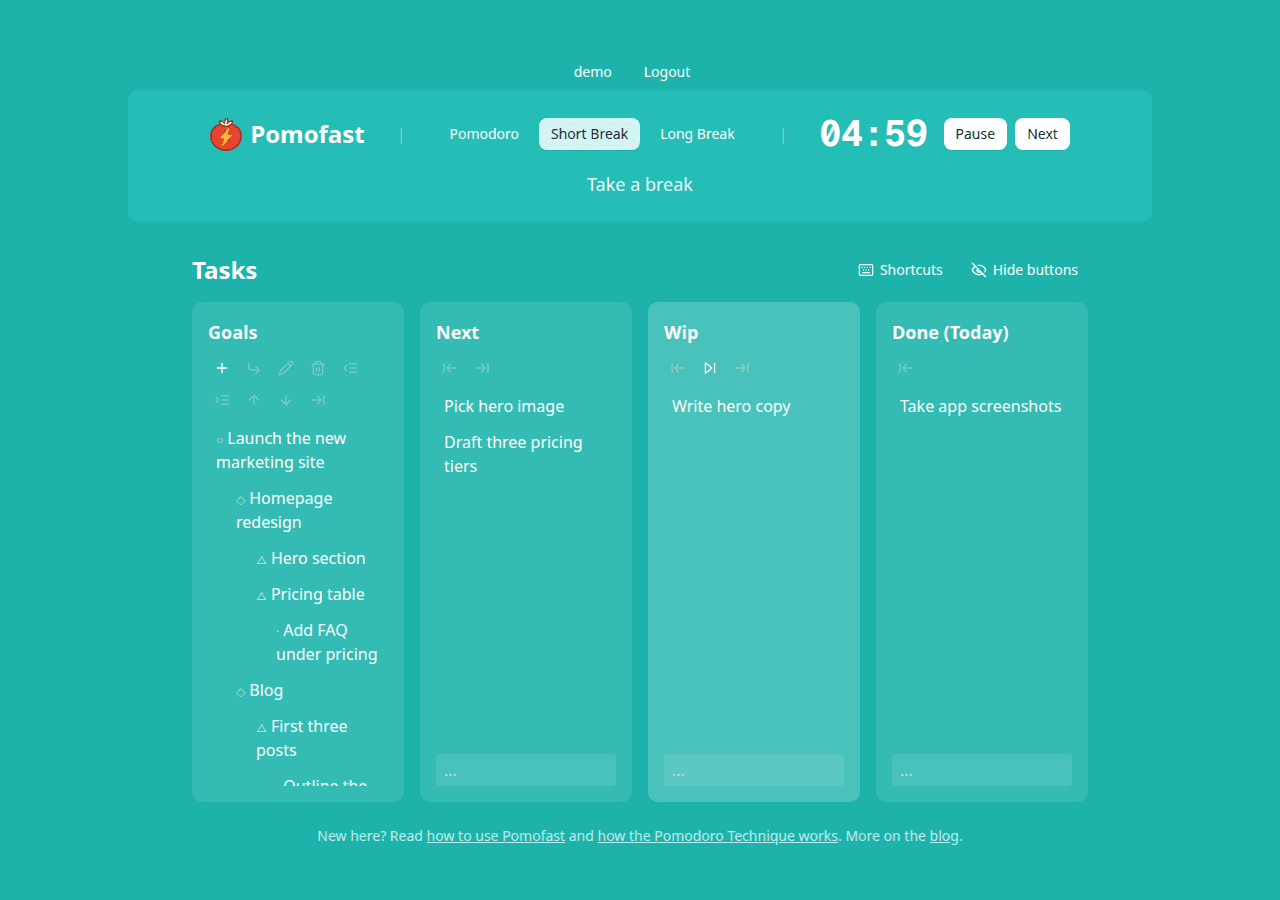
The difference from a plain timer is the task board underneath it. You decide what the next Pomodoro is for before it starts, by pulling a task into the Wip column, and the finished work lands in the Done column as a record of the day. If you are new to the app, Getting Started with Pomofast walks through it screen by screen.
Is 25 minutes right for you?
Twenty-five minutes is a default, not a law. Programmers sometimes prefer 50/10; writers sometimes prefer shorter bursts. The right length is the longest one you can reliably keep interruption-free. Start with the default, tick off a couple of weeks of sessions, and only then consider changing it. Whatever the number, keep the ratio: roughly one part rest to five parts work, and a longer rest after every four.
Frequently asked questions
How many pomodoros should I do in a day?
Most people manage 8 to 12 focused pomodoros in a full working day once meetings and admin are subtracted. Start by aiming for 6 and count what you actually complete for a week; that number is your real capacity, and planning around it beats planning around a fantasy.
What if I finish the task before the timer rings?
Use the remaining minutes to review what you did, tidy the result, or plan the next task. Cirillo calls this overlearning. Do not start an unrelated task, and do not end the pomodoro early; the interval is the unit you are training.
What should I do when someone interrupts a pomodoro?
Inform them you are in the middle of something, negotiate a time to get back to them (usually the next break), and write the request down so it is out of your head. If the interruption truly cannot wait, void the pomodoro and start a fresh one afterwards.
Does the Pomodoro Technique work for programming and deep work?
Yes, with one adjustment: many developers run longer intervals such as 50 minutes with a 10-minute break, because rebuilding mental context is expensive. Keep the structure (one task, a fixed interval, a real break) and tune the length to your work.