 Pomofast
Benefits of the Pomodoro Technique: What the Evidence Actually Shows
An evidence-based review of Pomodoro benefits for focus, breaks, fatigue and productivity—including mixed findings, limitations and practical advice.
By Sean Bennett · · 10 min read
The Pomodoro Technique has plausible benefits: it gives work a clear boundary, protects one task from interruptions, schedules recovery and makes effort countable. But the evidence does not support the usual internet promise that 25 minutes of work and 5 minutes of rest automatically make everyone more productive. Here is what controlled studies and research reviews actually show—and how to use the method without turning 25/5 into a rule you must obey.
The short answer
Pomodoro is best understood as a structure for doing focused work, not a scientifically optimized brain cycle. Direct research is still small and mostly involves university students. Some studies find that fixed work-and-break schedules improve perceived concentration and reduce fatigue; later studies find no advantage, or find that self-chosen breaks feel better. Across the wider break literature, short breaks have a clearer benefit for energy and fatigue than for objective performance.
| Popular claim | What the evidence supports |
|---|---|
| “Pomodoro improves focus.” | Possibly for some people and tasks. Direct results on perceived concentration are mixed. |
| “Five-minute breaks prevent fatigue.” | Short breaks generally reduce fatigue and increase vigor, but exact timing and task type matter. |
| “You will finish more work.” | Not established. Pomodoro studies have not consistently improved task completion or learning. |
| “Twenty-five minutes is the ideal focus span.” | No. There is no good evidence that 25/5 is a universal biological optimum. |
| “Tracking sessions helps progress.” | Progress monitoring helps goal attainment generally, but that evidence is not Pomodoro-specific. |
What direct Pomodoro studies found
A promising result for concentration—but not completion
In 2023, Biwer and colleagues randomly assigned 87 university students to choose their own breaks or follow systematic schedules: 24 minutes of work with a 6-minute break, or 12 minutes with a 3-minute break. The fixed groups reported less fatigue and distraction, more concentration and more motivation to resume. They also experienced the work as less difficult. However, the groups showed no significant difference in task completion or overall mental effort. The researchers relied heavily on self-reports and studied each participant’s first day of self-selected work, so the result is useful but preliminary. Read the full study in the British Journal of Educational Psychology.
An exact 25/5 comparison found no overall advantage
A 2025 experiment assigned 94 students to classic 25/5 Pomodoro, Flowtime or fully self-regulated breaks during a two-hour study session. The groups did not differ overall in motivation, perceived productivity, fatigue, task completion or flow. Motivation declined faster over time in the Pomodoro group than in the self-regulated group, and fatigue rose more steeply under Pomodoro. The authors concluded that none of the three schedules should be recommended over the others from this single study. The peer-reviewed article is freely available.
A larger experiment favoured flexible breaks for mood
In 2026, 176 students completed the same reading task using either self-regulated breaks or a fixed 12/3 schedule. Comprehension did not differ significantly. Students choosing their own breaks reported more energy, concentration and motivation, with less distraction. This was not the classic 25/5 protocol, and the authors noted limits in the performance measure, but it reinforces the case for matching break timing to the person and task. See the study record and abstract from Maastricht University.
Taken together, the direct evidence does not say that Pomodoro is useless. It says that the timer is a tool whose effect depends on the work, the break and the person using it. The benefits are more likely to come from the behaviours the method creates than from the number 25 itself.
Benefit 1: predictable recovery can reduce fatigue
Breaks are the part of Pomodoro with the strongest independent evidence. A 2022 systematic review and meta-analysis combined experiments on micro-breaks of 10 minutes or less. Short breaks produced small but statistically significant improvements in vigor and fatigue. They did not significantly improve overall performance, although longer micro-breaks were associated with better performance and results varied by task. Read the open-access PLOS ONE meta-analysis.
That is a worthwhile benefit even without a productivity jump. Feeling less depleted can make it easier to sustain a working day. It also explains why the quality of a break matters: recovery requires stepping away from the demands of the task. Email, messages and another difficult decision may be a change of subject, but they are not necessarily rest.
Benefit 2: one task gets a protected boundary
A Pomodoro is a pre-commitment: for this interval, this is the task. That rule may reduce voluntary switching to inboxes, messages and easier work. Research on “attention residue” found that thoughts about an unfinished task can persist after switching and impair performance on the next task. That study did not test Pomodoro, but it supports the method’s single-task rule. See Leroy’s experiments on attention residue and task switching.
The practical benefit is not superhuman concentration. It is a simpler response to distraction: capture the thought, defer it to the break and return to the one task already chosen. The fixed endpoint makes that deferral believable because “later” is at most a few minutes away.
Benefit 3: large work becomes a small commitment
“Finish the report” is open-ended. “Work on the introduction until the timer rings” has a known cost. Pomodoro separates starting a work interval from finishing the entire project. That can make an avoided task easier to approach, especially when the first action is concrete.
This is a sensible behavioural mechanism, not a well-proven Pomodoro outcome. The timer cannot rescue a vague task by itself. “Research the launch” is still ambiguous; “find three customer quotes for the launch brief” gives the interval a finish line. The technique works best when task definition happens before the countdown begins.
Benefit 4: effort and progress become visible
Counting completed focus sessions converts an indistinct afternoon into observable units. More importantly, recording what each session produced lets you compare intention with result. A meta-analysis of 138 randomized studies—not Pomodoro studies—found that interventions which increased progress monitoring also improved goal attainment, with larger effects when progress was physically recorded. Read the progress-monitoring meta-analysis.
The distinction between counting time and monitoring progress matters. Four timer completions do not prove that the important work moved. Pair every Pomodoro with a named task and record the actual result. Over time, those records can also improve estimates: you learn that a familiar report normally takes three sessions, not the one you keep hoping for.
Benefit 5: time can feel more controllable
Pomodoro decides in advance when work and rest happen, removing repeated negotiations with yourself. The wider time-management literature is encouraging here. A meta-analysis covering 158 studies and 53,957 participants found moderate relationships between time management, performance and wellbeing, plus a negative relationship with distress. The association with wellbeing was stronger than the association with performance. Much of that literature was correlational and it did not isolate Pomodoro, so it cannot establish that a kitchen timer will make someone happier. It does suggest that structuring and protecting time can be valuable beyond raw output. See the open-access time-management meta-analysis.
What the evidence does not show
- Twenty-five minutes is not a universal attention span. It is the traditional interval, not a neurological constant or a proven optimum.
- More Pomodoros do not automatically mean more valuable work. Activity counts can reward busyness unless every interval is tied to a meaningful result.
- A five-minute break does not reliably improve difficult cognitive performance. The micro-break meta-analysis found no significant benefit for cognitively demanding tasks.
- Forced breaks can interrupt useful momentum. Participants in several studies reported this, and newer comparisons sometimes favoured self-regulated breaks.
- Pomodoro is not a treatment. It can be a helpful work routine, but claims about treating ADHD, anxiety, burnout or other conditions require evidence the technique does not currently have.
An evidence-aligned way to use Pomodoro
- Name one observable result. Replace “work on presentation” with “draft the titles for five slides.”
- Protect the work interval. Silence notifications and keep a capture note for thoughts that can wait. Switching less is one of the behaviours the technique is meant to create.
- Start with 25/5 as an experiment. Do not treat it as a law. If stopping repeatedly harms complex work, a less rigid schedule may fit better.
- Make the break restorative. Stand, stretch, get water or look away from the screen. Resume email and administrative work in their own focus interval.
- Record the result, not just the tick. Note what changed during the session and whether the task is done, needs another interval or should be split.
- Review after a week. Compare task completion, fatigue and ease of starting. Keep the parts that help and adapt the parts that do not.
How Pomofast implements the useful parts
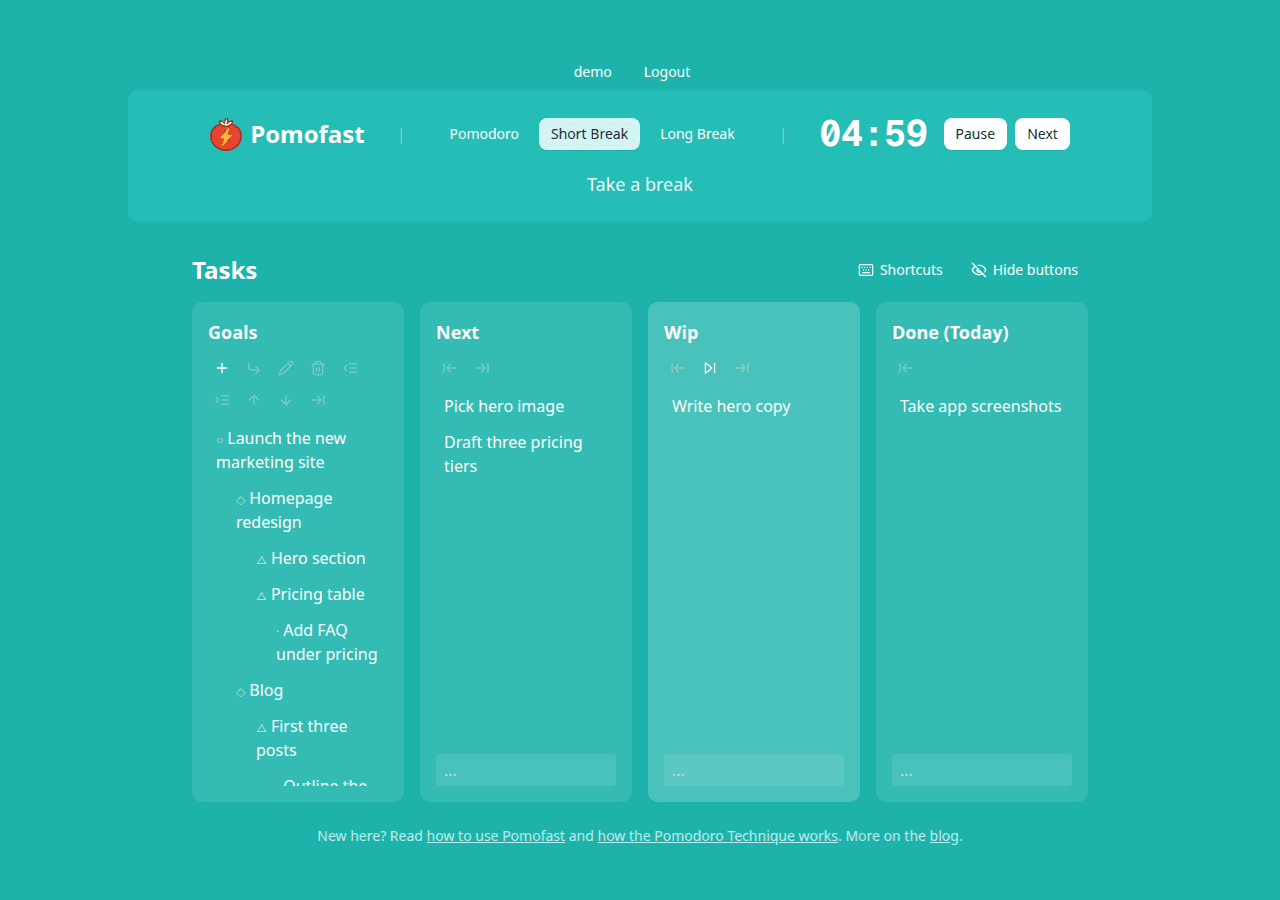
Pomofast combines the timer with a task board because timing is only one part of the method. The Goals tree breaks large outcomes into concrete tasks. Next holds a deliberate queue. Wip separates the chosen task from everything else, and the running timer displays its full path so the purpose remains visible. Done (Today) records the result rather than leaving you with a row of anonymous timer ticks.
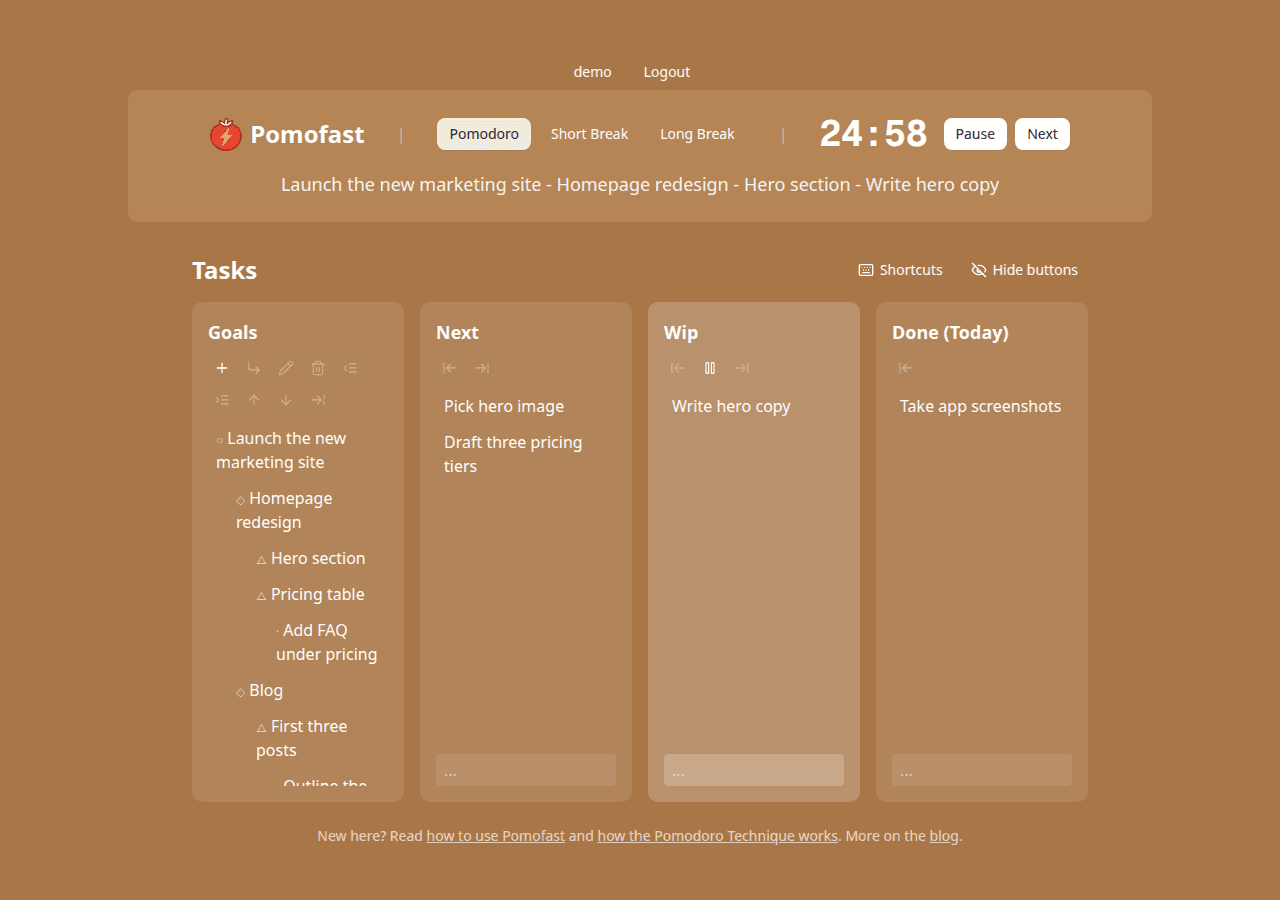
Out of the box, Pomofast uses a 25-minute focus session, a 5-minute short break and a 15-minute long break after every 4 focus sessions. A completed focus session switches to a break and waits for you to start it; when the break ends, the next focus session starts automatically. That transition supports returning to work, while the Pause and Next controls leave room for real life.
If starting and staying on task are specifically difficult because of ADHD, read Pomodoro and ADHD: How Timeboxing Can Help You Stay on Task. For the mechanics of the board, see Getting Started with Pomofast.
Research notes
- Biwer F, Wiradhany W, Oude Egbrink MGA, de Bruin ABH. Understanding effort regulation: Comparing ‘Pomodoro’ breaks and self-regulated breaks. British Journal of Educational Psychology. 2023.
- Smits EJC, Wenzel N, de Bruin ABH. Investigating the Effectiveness of Self-Regulated, Pomodoro, and Flowtime Break-Taking Techniques Among Students. Behavioral Sciences. 2025.
- Göksu A, Wiradhany W, de Bruin ABH. When to Take a Break: Comparing Effects of Systematic Short (Pomodoro) and Self-Regulated Breaks on Subjective Experience and Actual Learning. Behavioral Sciences. 2026.
- Albulescu P, et al. “Give me a break!” A systematic review and meta-analysis on the efficacy of micro-breaks for increasing well-being and performance. PLOS ONE. 2022.
- Harkin B, et al. Does monitoring goal progress promote goal attainment? A meta-analysis of the experimental evidence. Psychological Bulletin. 2016.
- Aeon B, Faber A, Panaccio A. Does time management work? A meta-analysis. PLOS ONE. 2021.
Frequently asked questions
Is the Pomodoro Technique scientifically proven?
Not in the strong sense often claimed online. Direct studies are few, relatively small and mostly involve university students. Results are mixed: fixed schedules sometimes improve perceived concentration and fatigue, but have not consistently improved productivity, task completion, learning or flow.
What is the best-supported benefit of Pomodoro?
The strongest related evidence is for the short breaks. A meta-analysis found that micro-breaks improved vigor and reduced fatigue, although they did not significantly improve overall performance. Pomodoro also creates useful structure for single-task work and progress tracking, but evidence for those mechanisms is mostly indirect.
Is 25 minutes of work and 5 minutes of rest optimal?
No universal optimum has been established. The 25/5 cycle is a practical convention. The right schedule depends on the task, the person and the kind of break; complex work may benefit from longer uninterrupted periods or self-chosen stopping points.
Does Pomodoro improve productivity?
It may help an individual work more deliberately, but controlled studies have not found a consistent productivity or task-completion advantage over flexible breaks. Measure completed outcomes, fatigue and ease of restarting for a week to determine whether it benefits your own work.
What should I do during a Pomodoro break?
Choose something that reduces the demands of the work you just stopped: stand, stretch, get water, look into the distance or walk briefly. Treating email or messages as a break may preserve the same cognitive demands instead of providing recovery.