 Pomofast
Pomodoro and ADHD: How Timeboxing Can Help You Stay on Task
How Pomodoro may support ADHD focus, task initiation and engagement—and how Pomofast turns the research into a practical work loop.
By Sean Bennett · · 9 min read
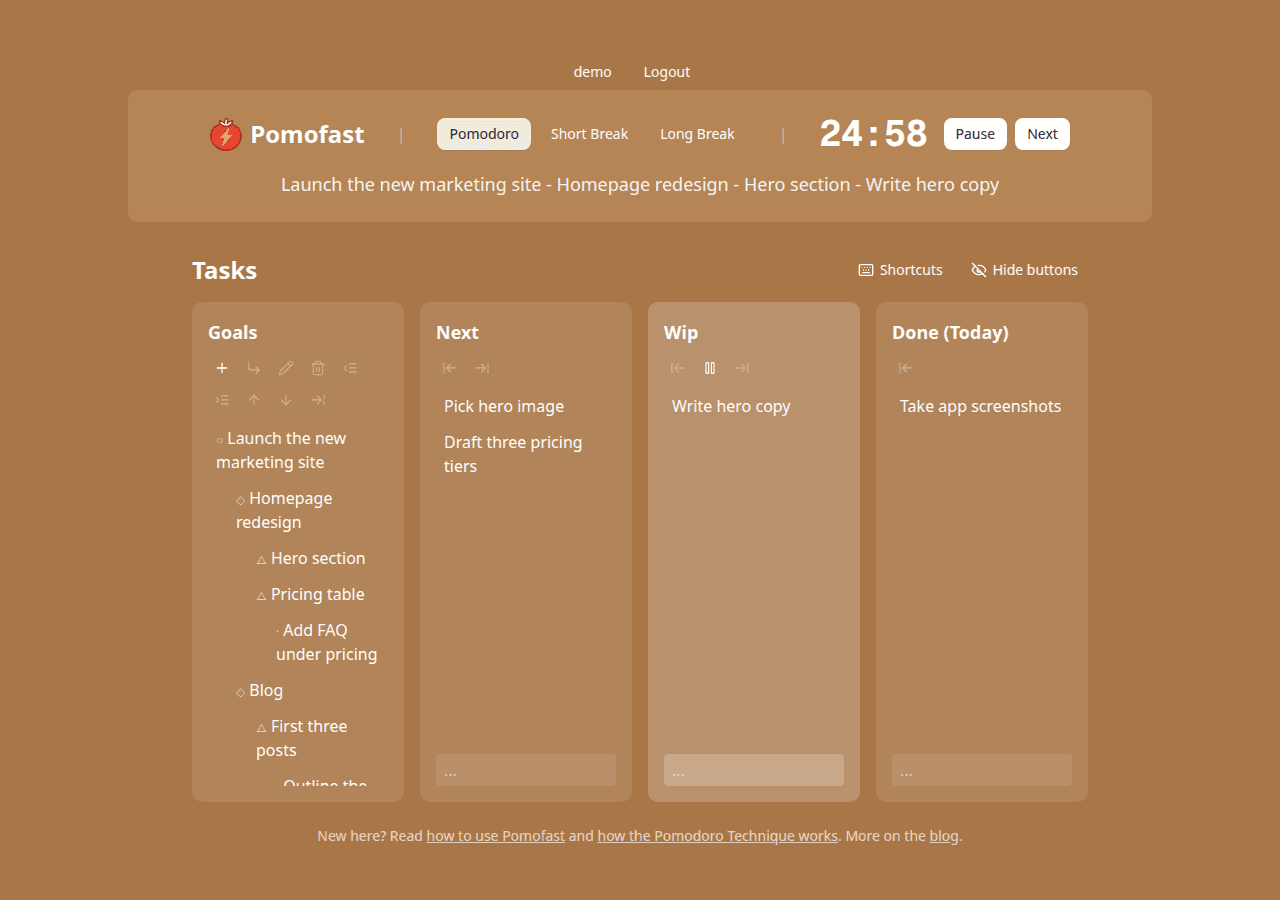
The Pomodoro Technique can help some people with ADHD stay engaged because it moves several jobs out of your head and into the environment: the timer makes time visible, the task list names what to do, and the next break is never far away. Pomofast puts those supports on one screen. It is a practical focus aid, not an ADHD treatment, and the distinction matters.
The honest answer: useful scaffolding, not a cure
There is not strong clinical evidence that the Pomodoro Technique itself treats ADHD. Most research tests the individual problems the method may help with—time perception, working memory, sustained effort and break regulation—or studies timed work in people who were not selected for ADHD. So the most defensible claim is also the most practical one: Pomodoro supplies external structure that can make starting, staying with a task and returning after a break easier.
ADHD also does not look the same in everyone. The US National Institute of Mental Health lists difficulty staying on task, organization, time management, procrastination and completing large projects among the ways adult ADHD can affect daily life. It also notes that symptoms vary and that established care can include medication and psychotherapy. A timer may support that care; it does not replace it. See the NIMH overview of ADHD in adults for diagnosis and treatment information.
Why Pomodoro can fit an ADHD brain
1. The countdown makes time concrete
“Work on this today” has no visible edge. A 25-minute countdown does. A 2024 systematic review and meta-analysis of time perception in ADHD combined 824 effect sizes and found a meaningful overall difference between ADHD and comparison groups. That does not prove that a timer fixes time perception. It does explain why moving time onto the screen can be a useful accommodation: you no longer have to estimate how long you have been working or when you are allowed to stop.
2. A bounded session is easier to approach than an open-ended project
“Finish the proposal” asks you to hold a large, uncertain commitment in mind. “Draft the three headings until the timer rings” asks for one concrete action with a known finish line. The Pomodoro promise is about showing up for the interval, not completing the whole project. That smaller promise can lower the emotional and planning cost of getting started.
3. One visible task reduces the amount you must keep in mind
A meta-analysis of 38 studies of working memory in adults with ADHD found moderate differences across verbal and visuospatial working-memory tasks. A focus system should not make you mentally rehearse the plan while doing the work. Writing the plan down, choosing one task for Wip and keeping its goal-to-task path in view turn memory work into something you can simply look at.
4. A nearby break gives distractions somewhere to wait
When an unrelated idea or urge appears, “not now” can feel indefinite. “At the next break” is specific and close. Research on reward timing is relevant here: a meta-analysis covering 37 comparisons between ADHD and control groups found that participants with ADHD chose smaller immediate rewards over larger delayed ones more often. A short work interval brings both relief and a sense of completion closer. This is a design rationale, not proof that Pomodoro changes reward processing.
5. Scheduled breaks reduce one more self-management decision
If you wait until you feel exhausted, the break often arrives late and runs long. In a randomized field study of 87 university students, people using systematic 24/6 or 12/3 work-and-break schedules reported less fatigue and distraction, more concentration and more motivation to resume than people choosing their own breaks. They did notcomplete more of their self-selected tasks, and the study was not specific to ADHD. Some participants also felt that scheduled breaks interrupted their flow. The finding is modest but useful: a timer can make effort feel more manageable even when it does not magically produce more output.
How Pomofast supports the whole focus loop
A standalone timer answers one question: how long should I work? Pomofast also keeps the answers to why this task, what is next and what did I finish? in the same view.
| Common point of friction | Pomofast’s support | What it changes |
|---|---|---|
| The project feels too large to enter | Goals → projects → features → tasks | You break an outcome down until the next physical action is clear. |
| Everything feels equally urgent | The Next queue | You choose a short list before the session instead of renegotiating priorities while working. |
| You drift and forget what you opened | Wip plus the full task path in the timer header | The screen keeps answering “what am I doing, and why?” |
| Time disappears | A large visible countdown | The session has a concrete boundary without mental timekeeping. |
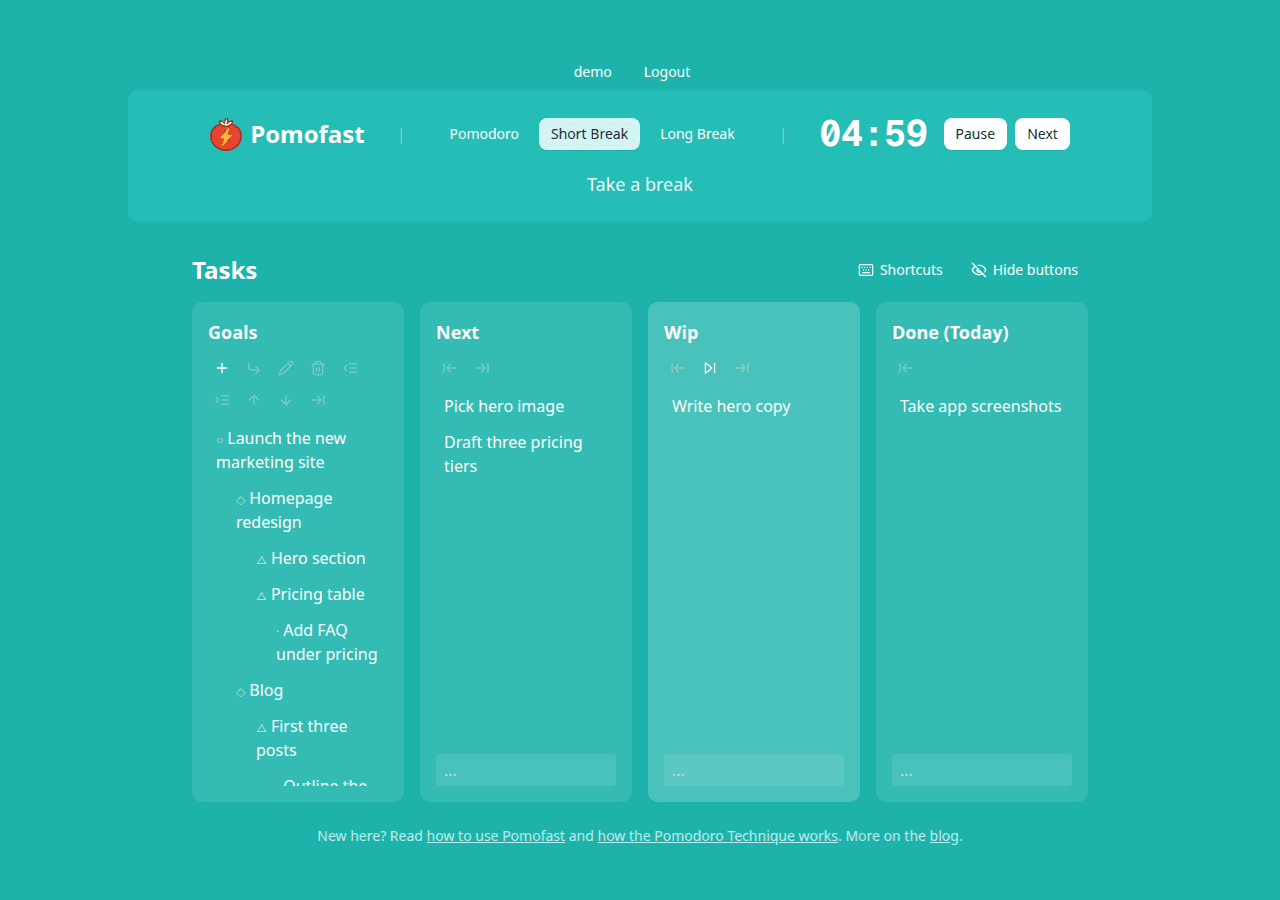
| Breaks are skipped or become open-ended | 5- and 15-minute break timers, alarms and colour changes | Work and rest become distinct phases with visible limits. |
| Progress feels invisible | Done (Today) | Finished tasks create immediate feedback and a concrete record of the day. |
An ADHD-friendly Pomofast workflow
- Make the task smaller than your resistance. Do not queue “website.” Queue “open the homepage file and draft three headings.” A task can be smaller than one Pomodoro.
- Keep Next short. Put only a few tasks in today’s queue. The rest can stay safely in the Goals tree, where it does not compete for your attention.
- Put one task in Wip. Pomofast can hold more, but treating Wip as a limit of one removes the invitation to switch whenever the current task becomes uncomfortable.
- Define the finish line before Start. Say what evidence should exist after the session: three headings, ten reviewed records, or one tested function. Then start the 25-minute timer.
- Park distractions. Keep paper beside you. Write the thought in a few words and return to the visible Wip task. Review the list during the break instead of turning every thought into a task switch.
- Move the work, not your standard. If the task is finished, move it to Done. If it needs another session, leave it in Wip and write the exact next action before the break.
- Take a real break. Start the 5-minute break, stand up, drink water or look away from the screen. After every 4 focus sessions, Pomofast offers a 15-minute long break. When a break ends, the next focus session starts automatically, removing one more decision at the return-to-work point.
What if 25 minutes does not work for you?
Twenty-five minutes is a starting point, not a test of character. It may feel too long on a difficult day, or it may interrupt you just as deep focus arrives. The goal is not perfect obedience to a kitchen-timer ritual; the goal is a repeatable way to re-engage with chosen work.
Start by changing the size of the task rather than demanding more motivation. Give the session a tiny first action and allow an imperfect Pomodoro to count. If the timer interrupts valuable momentum, use the last few seconds to write your exact next step so the break does not erase your place. If the ticking sound is distracting, pause the session and restart it without audio by muting the browser tab or site.
Watch the pattern for a week: Which tasks were easy to start? When did you abandon a session? Which breaks made it easier to return? Use that evidence to shape the routine. A productivity method should adapt to a person, not become another source of shame.
Where Pomodoro stops
Pomofast cannot diagnose ADHD, reduce symptoms by itself or decide which treatment is appropriate. If attention, impulsivity or organization problems regularly interfere with work, study, relationships or daily life, speak with a qualified health professional. Evidence-based treatment and workplace or school accommodations can matter far more than any timer.
What Pomofast can do is make the next work cycle less dependent on remembering the plan, sensing time accurately and repeatedly choosing to resist a distraction. The task is visible. The interval has an end. The break is already promised. And when the work is finished, Done makes the progress real.
Ready to try the workflow? Open Pomofast, or read the step-by-step guide to moving a task from Goals to Done.
Research notes
- National Institute of Mental Health. ADHD in Adults: 4 Things to Know. Updated 2024.
- Metcalfe KB, McFeaters CD, Voyer D. Time-Perception Deficits in Attention-Deficit/Hyperactivity Disorder: A Systematic Review and Meta-Analysis. Developmental Neuropsychology. 2024.
- Alderson RM, Kasper LJ, Hudec KL, Patros CHG. Attention-deficit/hyperactivity disorder (ADHD) and working memory in adults: a meta-analytic review. Neuropsychology. 2013.
- Marx I, et al. ADHD and the Choice of Small Immediate Over Larger Delayed Rewards. Journal of Attention Disorders. 2021.
- Biwer F, Wiradhany W, Oude Egbrink MGA, de Bruin ABH. Understanding effort regulation: Comparing ‘Pomodoro’ breaks and self-regulated breaks. British Journal of Educational Psychology. 2023.
Frequently asked questions
Does the Pomodoro Technique treat or cure ADHD?
No. Pomodoro is a time-management method, not an ADHD treatment. It may provide useful external structure for time, tasks and breaks, but it cannot diagnose ADHD or replace professional assessment, medication, psychotherapy or accommodations.
Why can a Pomodoro timer help someone with ADHD focus?
A timer gives work a visible endpoint, brings the next break closer, and removes the need to judge when to stop. Pairing it with one written task can also reduce how much of the plan must be held in working memory. These mechanisms fit common ADHD difficulties, although direct ADHD-specific evidence for Pomodoro is limited.
Is 25 minutes the best focus interval for ADHD?
Not necessarily. Twenty-five minutes is a conventional starting point, and ADHD varies greatly between people and from day to day. Judge the method by whether it helps you start, stay with the chosen task and return after a break—not by perfect compliance with one interval length.
What makes Pomofast different from a basic ADHD focus timer?
Pomofast keeps the timer beside a task workflow. Goals hold the larger reason, Next holds the short queue, Wip identifies the active work, the running header shows its full path, and Done (Today) makes completed work visible. The aim is to support the decisions around a focus session as well as the minutes inside it.